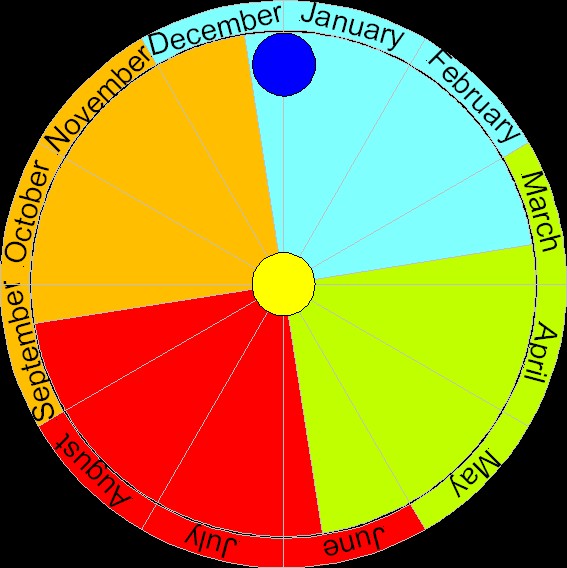
This graphic shows the Earth's postition on its orbit around the sun on January 1st with colors that indicate the northern hemisphere's seasons. We have passed our orbit's closest point to the sun on December 18th which was the winter solstice. This means that our days get longer again and the incoming solar radiation will increase every day ( - so why is the northern hemisphere still cooling down for the next few weeks? It means that the emitted energy is greater than the absorbed energy - this sounds easy but is probably complex as for example the absorbed energy isn't the same as the incoming, the amount of absorbed energy depends on the greenhouse effect of our atmosphere - and is the incoming energy the sun emits constant?), but around the solstice the differences are small. And it also means that astronomically seen we are in winter, popularly seen even almost in the middle of it. In Europe the reality proves at the moment that the solar altitude doesn't guarantee the seasonality of the weather. Global wind and sea currents have probably a crucial influence. And who really knows what makes them shift (or not) with the seasonal changes?