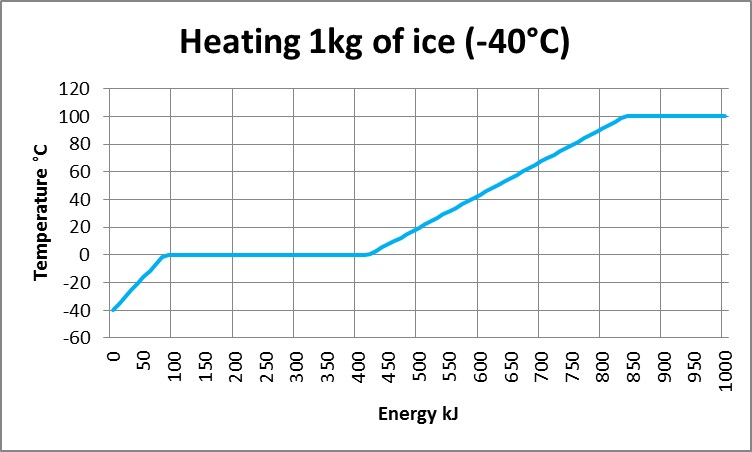
Here you can see how the temperature changes if you heat a 1kg block of ice with -40°C steadily.
As you can see ice needs less energy to warm up than water. And there is a long buffer zone because it needs a lot of energy to bring 1kg ice of 0°C to 1kg water of 0°C (heat of fusion). This must be taken into account:
It shows that temperature changes depend also on the current humidity: the energy that is needed to heat up ice from -20°C to -10°C is swallowed by the heat of fusion which means: if the same energy change takes place around 0°C instead of at -20°C, there wouldn't be any observable temperature change. Which means that our change of several degrees C around the melting point means an even bigger difference in energy than what took place in the interior of Alaska. I suppose that the effect in temperature change is the bigger the drier the air is as then you need less energy to shift temperature.
So perhaps we should rather discuss energy changes than temperature changes...