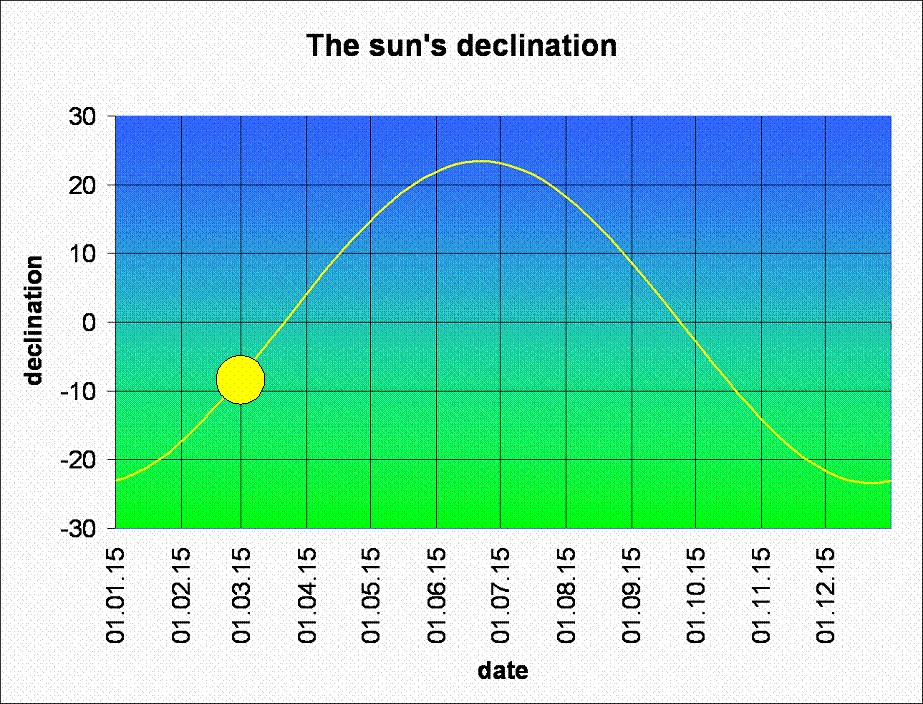
This graphic shows the sun's declination on March 1st. We have about the same daylength as in mid October. The sun's declination will continue to increase significantly every day for the next three months. The days are clearly longer in the north/ shorter in the south now, until on March 20th = eqinox (at 22.45 UTC our planet reaches this point of it's orbit), everywhere on Earth day and night are 12 hours, and after that we inherit the half-year period of longer days than nights from the southern hemisphere. Still the northern (southern) hemisphere gets more (less) energy from day to day and as from the equinox the northern hemisphere will get more energy than the southern. It's not surprising that the turning points of polar sea ice cover are in March: the minimum in the Antarctic and the maximum in the Arctic - for certain reasons they do not coincide. The peak of winter (summer) is over now and the high / low incoming solar energy induces many changes in nature: spring / autumn is on its way.