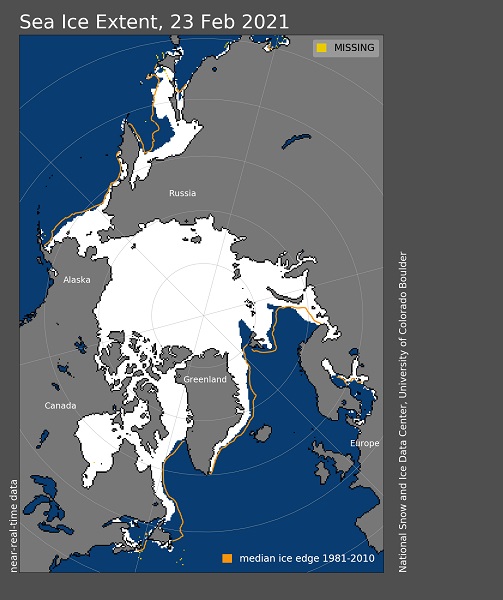
February 23th, 2021: Arctic sea ice extent ***********************
A lopsided January: Arctic sea ice extent for January 2021 tracked below average, with the monthly average finishing sixth lowest in the satellite record. While air temperatures were well above average on the Atlantic side of the Arctic, air temperatures were strongly below average over Siberia. A warm spell hit the Canadian Arctic, and rain fell on snow over Nunavut, Canada. According to NASA and the National Oceanic and Atmospheric Administration (NOAA), 2020 tied for the highest global annual temperature with 2016.
Overview of conditions: Arctic sea ice extent Jan 2021: Arctic sea ice extent averaged for January 2021 was 13.48 million square kilometers (5.20 million square miles). This was 400,000 square kilometers (154,000 square miles) above the record low set in 2018 and 940,000 square kilometers (363,000 square miles) below the 1981 to 2010 average. Extent continued to track below average in the Barents Sea, Baffin Bay, Davis Strait, and the Labrador Sea. Extent was also below average on the Russian side of the Bering Sea, but elsewhere the ice edge was near its average location for this time of year. Ice extent expanded through the month on the Alaskan side of the Bering Sea and within the Sea of Okhotsk. Ice growth was also prominent in the northern Barents Sea west of Svalbard.
Conditions in context: During January, sea ice extent tracked below measured values for most years except 2017 and 2016, but by the middle of the month, extent rose above the average for the last 10 years, from 2011 to 2020. Overall, in January the Arctic gained 1.42 million square kilometers (548,000 square miles) of ice. Air temperatures at the 925 mb level (about 2,500 feet above sea level) in January were considerably above average over the Atlantic side of the Arctic, especially in the Baffin Bay region (up to 8 degrees Celsius or 14 degrees Fahrenheit) above average. Temperatures were 2 to 6 degrees Celsius (4 to 11 degrees Fahrenheit) above average over Canada and Alaska. By sharp contrast, air temperatures were between 6 and 8 degrees Celsius (11 and 14 degrees Fahrenheit) below average over Siberia. The atmospheric circulation associated with this lopsided pattern was dominated by high pressure over Siberia and low pressure over the Northern North Atlantic and Pacific Ocean.
Image courtesy of the National Snow and Ice Data Center, University of Colorado, Boulder (https://nsidc.org/arcticseaicenews/). Data source see http://nsidc.org/arcticseaicenews/about-the-data/