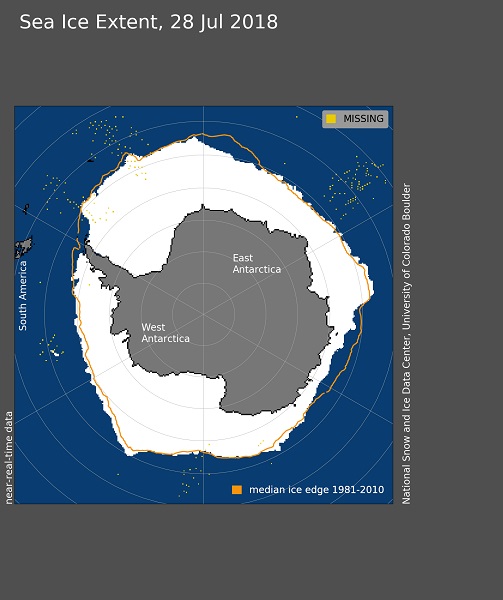
July 29th, 2018: Antarctic sea ice extent ***********************
Ice loss speeds up during second half of July
Arctic sea ice extent declined rapidly the latter half of July, despite the persistence of low sea level pressure over the Arctic Ocean and generally cool conditions. At the same time, unusually high sea level pressure persisted over the United Kingdom and Scandinavia, where several new record high temperatures were reached, fostering extensive wildfires.
Overview of conditions
Arctic sea ice extent for July 2018 averaged 8.22 million square kilometers (3.20 million square miles). This was 1.25 million square kilometers (483,000 square miles) below the 1981 to 2010 long-term average sea ice extent, and 550,000 square kilometers (212,000 square miles) above the record low for the month set in July 2012. July 2018 was the ninth lowest July extent in the satellite record.
Despite finishing ninth lowest in the monthly average, ice loss was rapid during the month. As a result, by July 31 daily extent tracked fourth lowest in the satellite record, just below the extent seen last year at this time, and also just above that seen in 2007, 2011, and 2012. Extent remained unusually low in the Atlantic sector of the Arctic, including the Barents, Kara, Laptev, and East Greenland Seas, whereas the ice edge in the Beaufort and East Siberian Seas remained near average. By the end of July, the ice within Hudson Bay had all melted out and the ice edge in the Chukchi Sea had also retreated far north of its average position for this time of year. This pattern is in stark contrast to last year when by July’s end, the ice edge was located far north of its usual position in the Beaufort and East Siberian Seas while with ice on the Atlantic side, extent was near average.
Image courtesy of the National Snow and Ice Data Center, University of Colorado, Boulder (https://nsidc.org/arcticseaicenews/). Data source see http://nsidc.org/arcticseaicenews/about-the-data/