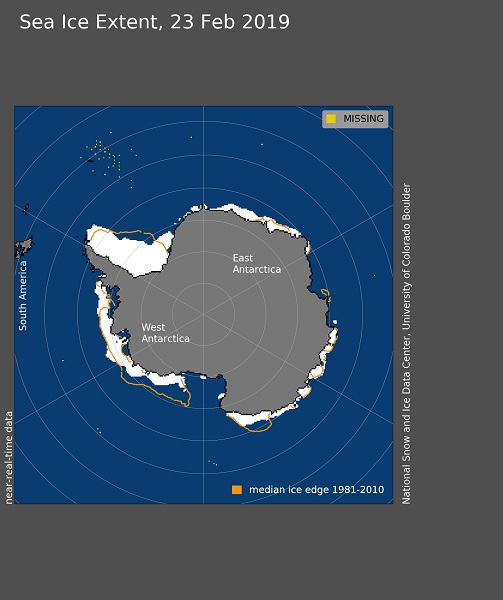
February 24th, 2019: Antarctic sea ice extent ***********************
Ho hum February it may be, unless we speak of the Bering Sea (March 4, 2019): Arctic sea ice extent for February 2019 was the seventh lowest in the satellite record for the month, tying with 2015. So far this winter, sea ice extent has remained above the 2017 record low maximum. Extent in the northern Barents Sea, which has been quite low in recent years from “Atlantification,” is closer to average this February. Extent is very low in the Bering Sea at the end of February after unusual ice loss throughout the month. In Antarctica, the sea ice minimum may have been reached on both February 28 and March 1. Overview of conditions: Arctic sea ice extent for February 2019 averaged 14.40 million square kilometers (5.56 million square miles). This was 900,000 square kilometers (347,000 square miles) below the 1981 to 2010 long-term average extent, and 450,000 square kilometers (174,000 square miles) above the record low for the month set in February 2018. For the Arctic as a whole, February 2019 tied with 2015 for the seventh lowest average February extent in the 1979 to 2019 satellite record. The daily average ice growth rate of 19,400 square kilometers (7,500 square miles) was near the long term average of 20,200 square kilometers (7,800 square miles). Ice growth during February primarily occurred in the Barents Sea and in the Sea of Okhotsk. Some ice growth was also observed in the Labrador Sea. Recent years have seen reduced ice coverage in the northern Barents Sea related to “Atlantification”—a greater influence of warm waters brought in from the Atlantic (see previous post). Sea ice extent toward the end of February 2019, however, was much closer to average in this region. By sharp contrast, sea ice extent drastically retreated in the Bering Sea in February and continues to as of this post.
Image courtesy of the National Snow and Ice Data Center, University of Colorado, Boulder (https://nsidc.org/arcticseaicenews/). Data source see http://nsidc.org/arcticseaicenews/about-the-data/