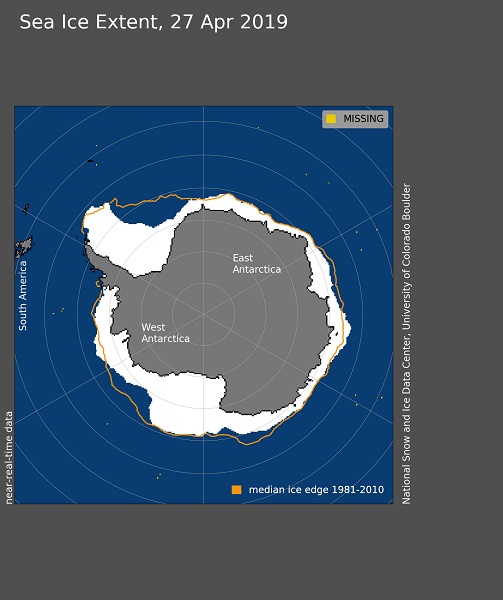
April 28th, 2019: Antarctic sea ice extent ***********************
Spring arrives in the Arctic (April 3, 2019)
Arctic sea ice extent appears to have reached its maximum extent on March 13, marking the beginning of the sea ice melt season. Since the maximum, sea ice extent has been tracking at record low levels. In the Bering Sea, extent increased through the middle of March after setting record lows—only to drop sharply again.
Overview of conditions
Arctic sea ice extent for March averaged 14.55 million square kilometers (5.62 million square miles), tying with 2011 for the seventh lowest extent in the 40-year satellite record. This is 880,000 square kilometers (340,000 square miles) below the 1981 to 2010 average and 260,000 square kilometers (100,400 square miles) above the lowest March average, which occurred in 2017.
The Bering Sea, which had been nearly ice free at the beginning of March, saw gains in extent through the middle of the month. However, those gains were short lived as extent dropped sharply during the last week of March. The Bering Sea typically reaches its maximum ice extent in late March or early April. This year, the maximum occurred in late January and was 34.5 percent below the 1981 to 2010 average maximum. These late-March sea ice extent losses in the Bering Sea accelerated the decline of total Arctic sea ice extent. By April 1, Arctic extent was at a record low for that date.
Other signs of spring are emerging. A substantial amount of ice retreated in the Gulf of St. Lawrence and the Sea of Okhotsk, as well as in the Barents Sea. Late in the month, small areas of open water were observed in sea ice fields from the University of Bremen, particularly near the shores of the Laptev and Kara Seas, the Sea of Okhotsk, and off of northwestern Alaska.
Image courtesy of the National Snow and Ice Data Center, University of Colorado, Boulder (https://nsidc.org/arcticseaicenews/). Data source see http://nsidc.org/arcticseaicenews/about-the-data/