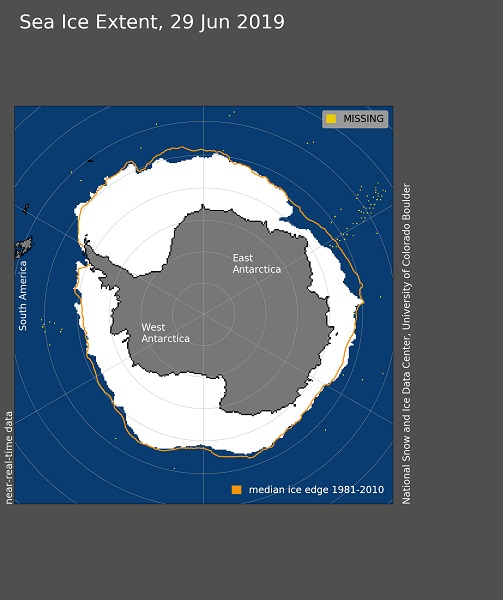
June 30th, 2019: Antarctic sea ice extent ***********************
Warm May in the Arctic sets the stage (June 4, 2019):
May saw above average temperatures over nearly all of the Arctic Ocean, Baffin Bay, and Greenland. Early sea ice retreat in the Bering Sea extended into the southern Chukchi Sea. Northern Baffin Bay and the Nares Strait have low ice cover. By month’s end, open water extended along the northeastern Alaskan and northwestern Canadian coasts, all well ahead of schedule. However, this was partly balanced by slower-than-average ice loss in the Barents Sea. At the end of May, Arctic sea ice daily extent stood at second lowest in the 40-year satellite record.
Arctic sea ice extent averaged for May was 12.16 million square kilometers (4.70 million square miles). This is 1.13 million square kilometers (436,000 square miles) below the 1981 to 2010 average and 240,000 square kilometers (93,000 square miles) above the previous record low for the month set in May 2016. The month saw rapid ice loss in the Bering Sea and southern Chukchi Sea. During the second half of the month, an extended coastal polynya opened along the northwestern coast of the Beaufort Sea extending into the Mackenzie River Delta area. Visible MODIS imagery shows many large ice floes interspersed with open water along the ice edge and fracturing of ice further within the pack.
Although ice loss in the Barents Sea was rapid in early May, it subsequently slowed and extent slightly increased late in the month. There was nevertheless an overall ice retreat for May as a whole. Around mid-month, a polynya began to open at the north end of Baffin Bay, near the Nares Strait. At about this time, an ice arch that restrains southward ice drift in the Lincoln Sea began to fail, allowing transport of ice through the strait and creating a small polynya northwest of Greenland (discussed below). By the end of May, other polynyas started to form around the New Siberian Islands as well as Severnaya Zemlya, and open water began to develop along coastal regions in the Kara Sea and in northern Hudson Bay.
Image courtesy of the National Snow and Ice Data Center, University of Colorado, Boulder (https://nsidc.org/arcticseaicenews/). Data source see http://nsidc.org/arcticseaicenews/about-the-data/