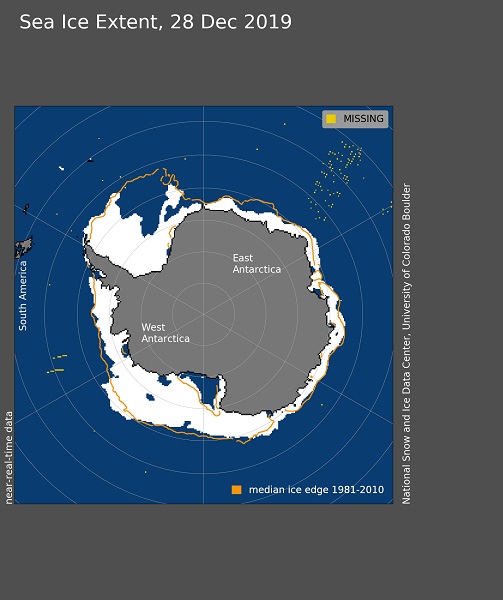
December 28th, 2019: Antarctic sea ice extent ***********************
Arctic sea ice extent for November 2019 ended up at second lowest in the 41-year satellite record. Regionally, extent remains well below average in the Chukchi Sea, Hudson Bay, and Davis Strait.
At the end of November and through the first week of December, daily extent was tracking third lowest in the satellite record, behind 2006 and 2016. Average ice extent for the month, however, finished second lowest in the passive microwave satellite record at 9.33 million square kilometers (3.60 million square miles). This was 670,000 square kilometers (259,000 square miles) above the 2016 record low for the month and 1.37 million square kilometers (529,000 square miles) below the 1981 to 2010 average. Regionally, extent remains well below average in the Chukchi Sea, as well as in Hudson Bay and Davis Strait. Extent is also below average in the Barents Sea, but not as pronounced as has been observed in recent years. Ice now extends to the shore along most of the Russian Arctic and along the coast of the Beaufort Sea. Extent is near average in the East Greenland Sea.
The daily growth rate for November was generally steady, averaging 98,600 square kilometers (38,100 square miles) per day, compared to the 1981 to 2010 average of 69,600 square kilometers (26,900 square miles). Overall, ice extent increased by 2.75 million square kilometers (1.06 million square miles) through the month, somewhat larger than the 1981 to 2010 average for the month of 2.07 million square kilometers (799,000 square miles).
Average November air temperatures at the 925 hPa level (about 2,500 feet above the surface) were 2 to 4 degrees Celsius (4 to 7 degrees Fahrenheit) above average over the East Siberian, Beaufort, and Chukchi Seas, but near average or only slightly above average over the remainder of the Arctic Ocean. It was unusually warm, up to 6 degrees Celsius (11 degrees Fahrenheit) above average, over Greenland (Figure 2b). The warmth over the East Siberian, Chukchi, and Beaufort Seas is consistent with mean low pressure at sea level for the month centered north of East Siberian Sea, drawing in warmth from the south. Above average temperatures over the Chukchi Sea also reflect remaining areas of open water; indeed, at the surface, November temperatures in the Chukchi Sea were 10 to 12 degrees Celsius (18 to 22 degrees Fahrenheit) above average. Such high surface temperatures in this area will remain until the upper ocean losses its remaining heat and ice begins to form.
Image courtesy of the National Snow and Ice Data Center, University of Colorado, Boulder (https://nsidc.org/arcticseaicenews/). Data source see http://nsidc.org/arcticseaicenews/about-the-data/