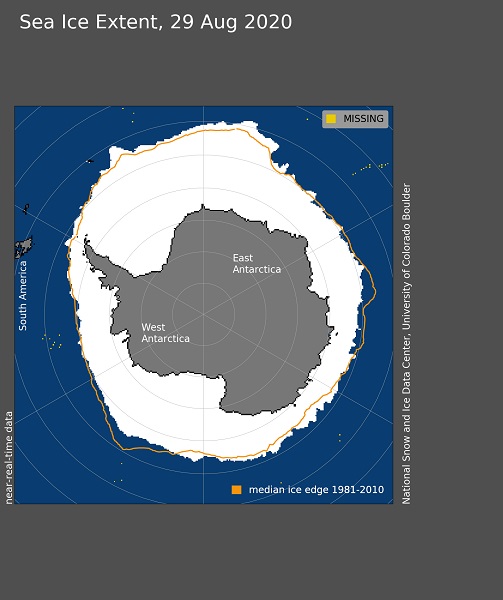
August 30th, 2020: Antarctic sea ice extent ***********************
Summer’s Last Stand (August 18, 2020):
While the Arctic summer is waning, sea ice extent continues to drop. In early August, ice-free pockets began to develop in the Beaufort and Chukchi Seas and expanded steadily through the first half of the month.
Sea ice extent stood at 5.15 million square kilometers (1.99 million square miles) on August 17, essentially tied with 2007 for the third lowest extent for the date since the satellite record began in 1979. The August 17 extent was lower only in 2012 and 2019. The most notable feature during the first half of August was the development of substantial openings of the sea ice north of Alaska within the Beaufort and Chukchi Seas. This may be related to the mid-July storm that passed and spread out the ice cover, creating openings in the sea ice.
The reduced concentration patches and initial openings were first observed in higher-resolution Japan Aerospace Exploration Agency (JAXA) Advanced Microwave Scanning Radiometer 2 (AMSR2) fields from the University of Bremen. By the middle of the month, the ice-free areas had greatly expanded. Meanwhile, another open water patch developed north of the Mackenzie River delta. Persistent offshore winds have also moved the pack ice edge northward from the northern Greenland and Ellesmere coasts.
The Northern Sea Route has been open for a few weeks. The Northwest Passage appears to be mostly ice-free with a little ice remaining within Victoria Strait. The deeper Parry Channel still contains a substantial amount of sea ice and will likely not open this year.
The end of the summer melt season, when the Arctic sea ice extent reaches its seasonal minimum, is likely about three to four weeks away.
Past ice-free Arctic Oceans
Climate models are projecting that under continued warming trends, the Arctic Ocean may become substantially ice-free during the summer within the next 30 years. Such a state would be unprecedented for at least thousands of years. However, such conditions may have existed during the Last Interglacial (LIG) period, about 130,000 to 116,000 years before present, when summer Arctic air temperatures were 4 to 5 degrees Celsius (7 to 9 degrees Fahrenheit) above pre-industrial levels. Previous model simulations were unable to capture the reconstruction of LIG Arctic temperatures, and a likely cause was a simplified treatment of sea ice that did not represent the influence of melt ponds on summer sea ice loss. The latest version of the UK Hadley Centre Global Environment Model version 3 (HadGEM3) climate model includes more complex characterization of melt ponds. In a recent paleoclimate study, this model was able to reproduce the reconstructed estimates of summer Arctic air temperatures during the LIG. This supports previous studies showing that melt pond formation is a key factor in the loss of summer sea ice because formation of melt ponds earlier in the season results in more absorption of solar energy through the summer and therefore more ice melt. ASINA team member Julienne Stroeve is a co-author on the study.
Farewell to the Milne Ice Shelf
Another recent notable event in the Arctic was the calving of a large area of the Milne Ice Shelf off Ellesmere Island in Nunavut, Canada, in late July. The Milne Ice Shelf had been Canada’s last intact Arctic ice shelf. A piece of the shelf measuring about 81 square kilometers (31 square miles), which made up about 43 percent of the total ice shelf area, broke off on July 30 and 31. Warm air temperatures and offshore winds likely triggered the ice shelf collapse. Offshore winds move the perennial sea ice cover north from the coast, reducing the compressive forces that hold the shelf in, and potentially contribute to basal melting of the ice by allowing solar energy to warm the upper ocean layer. Polar explorer Robert Peary discovered the Canadian Arctic ice shelves, once a single 9,000-square kilometer (3,475-square mile) sheet, in 1902. Although evidence from seal remains and driftwood suggests they were thousands of years old, they have dwindled dramatically and now comprise of only a few small ice-covered fragments in inlets along the northernmost coast of Canada.
Image courtesy of the National Snow and Ice Data Center, University of Colorado, Boulder (https://nsidc.org/arcticseaicenews/). Data source see http://nsidc.org/arcticseaicenews/about-the-data/