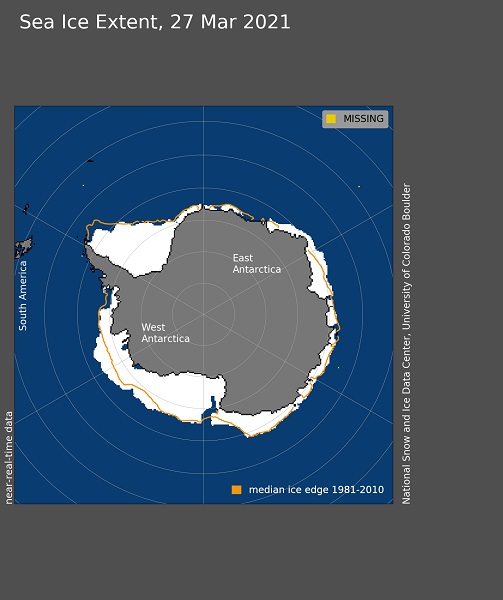
March 28th, 2021: Antarctic sea ice extent ***********************
Arctic sea ice reaches an uneventful maximum
Arctic sea ice appears to have reached its maximum extent on March 21, 2021, tying for seventh lowest in the 43-year satellite record. NSIDC will post a detailed analysis of the 2020 to 2021 winter sea ice conditions in our regular monthly post in early April.
On March 21, 2021, Arctic sea ice likely reached its maximum extent for the year, at 14.77 million square kilometers (5.70 million square miles), tying for the seventh lowest extent in the satellite record with 2007. This year’s maximum extent is 870,000 square kilometers (336,000 square miles) below the 1981 to 2010 average maximum of 15.64 million square kilometers (6.04 million square miles) and 360,000 square kilometers (139,000 square miles) above the lowest maximum of 14.41 million square kilometers (5.56 million square miles) set on March 7, 2017. Prior to 2019, the four lowest maximum extents occurred from 2015 to 2018.
The date of the maximum this year, March 21, was nine days later than the 1981 to 2010 median date of March 12.
The minimum in the south
Antarctic sea ice extent reached its minimum around February 21, during the period of missing data of which we had notified data users. After February 21, sea ice began a rapid increase in extent caused by the early rapid sea ice growth in the Amundsen and eastern Ross Seas. Advanced Microwave Scanning Radiometer 2 (AMSR-2) data, which was not impacted by the outage, confirms that the minimum was reached on or near February 21.
Sea ice extent has trended below average again after several months in mid- to late 2020 above the 1981 to 2010 average. However, the 2021 minimum extent is twelfth lowest in the satellite record and far from the record low extent, which occurred in 2017. Below-average extents were present in the northern Weddell and eastern Ross Seas, while the Bellingshausen Sea and the Wilkes Land Coast were near average (Figure 4).
Image courtesy of the National Snow and Ice Data Center, University of Colorado, Boulder (https://nsidc.org/arcticseaicenews/). Data source see http://nsidc.org/arcticseaicenews/about-the-data/