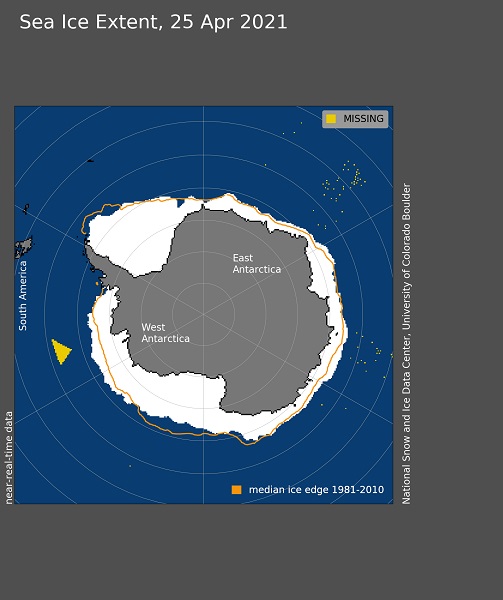
April 25th, 2021: Antarctic sea ice extent ***********************
A step in our spring: May 5, 2021: The spring decline in Arctic sea ice extent continued at varying rates through the month of April, highlighted by a mid-month pause. Above average air temperatures and low sea level pressure dominated on the Atlantic side of the Arctic, while near average conditions ruled elsewhere.
Overview of conditions: Arctic sea ice extent averaged for April 2021 was 13.84 million square kilometers (5.34 million square miles). This was 410,000 square kilometers (158,000 square miles) above the record low for the month set in 2019 and 850,000 square kilometers (328,000 square miles) below the 1981 to 2010 average. The average extent for the month ranks sixth lowest in the passive microwave satellite record. Extent was notably low in the Barents and Bering Seas as well as the Labrador Sea. Elsewhere, extent was close to or somewhat below average. The largest ice loss during April was in the Sea of Okhotsk and the Labrador Sea, with smaller losses along the southern edge of the Bering Sea, and in the eastern Barents Sea near the coast of Novaya Zemlya.
Conditions in context: Sea ice extent remained below the tenth percentile range throughout the month of April. However, rate of decline was variable. Notably, the decline paused, and extent even slightly increased between April 14 and April 19. This was largely because of an increase in sea ice in the northern Barents Sea, particularly off the northwest coast of Novaya Zemlya.
This temporary ice expansion appears to have been primarily driven by low sea level pressure centered over the Laptev Sea. This led to winds from the north in the northern Barents Sea, pushing ice southward. The sea level pressure pattern for the full month featured low pressure centered in the Barents Sea, north of the Scandinavian coast; bringing warm winds from the south and above average monthly temperatures in the region. Elsewhere in the Arctic, conditions were more moderate with 925 mb temperatures 1 to 3 degrees Celsius (2 to 5 degrees Fahrenheit) above average and weak high pressure.
Antarctica: In the Antarctic, autumn is now in full swing, but ice growth has been somewhat sluggish through the month. At the beginning of the month, extent was between the seventy-fifth and ninetieth percentile range of the 1981 to 2010 climatology. By the end of the month, extent was within the inner quartile range and just above the median.
Antarctic extent for April 2021 was 7.08 million square kilometers (2.73 million square miles), 230,000 square kilometers (88,800 square miles) above the 1981 to 2010 average. Extent was low in the northwestern Weddell Sea region and northern Ross Sea, and both areas had temperatures 3 to 8 degrees Celsius (5 to 14 degrees Fahrenheit) above the reference period. Sea ice extent was generally above average elsewhere, particularly in the Amundsen Sea, where rather cool conditions prevailed for April, at 1 to 3 degrees Celsius (2 to 5 degrees Fahrenheit) below average.
Image courtesy of the National Snow and Ice Data Center, University of Colorado, Boulder (https://nsidc.org/arcticseaicenews/). Data source see http://nsidc.org/arcticseaicenews/about-the-data/