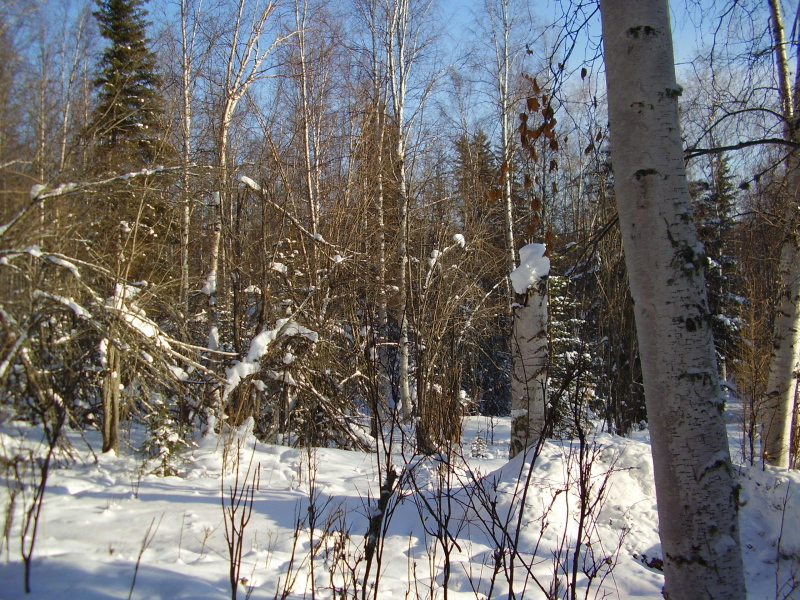
The air temperature when I took the pictures was about -12C. The
first image, 20002, was taken looking to the South. You can see a
snow pile or berm on the right of the photo since I took it standing
at the end of our driveway and the berm is from the snow that Bill
pushed up with the snowplow. To the left of the berm there is a tall
birch stump left over from a scary experience a number of years ago
when a strong wind blew the tree down. It fortunately just missed our
greenhouse, which is to the right of the picture. The tree was an old
one and the heart wood had rotted and so weakened the tree. The
shrubs in the foreground are willow. The second image, 20004, was
taken looking East. I walked down to just past the snow berm in the
first photo and then turned to my left (East) and took the picture. I
decided to do this because I was concerned that when the willows in
the foreground of the first picture leafed out they would screen the
picture and it would be difficult to see much at all. In the second
picture you can see some short twigs sticking above the snow. These
are also willows but I believe they have been browsed by moose. That
is why they are so short.
Moose have no upper incisor teeth so when they bite a twig they pinch
it with their lower incisors and tongue and lips and rip it off the
stem. You can tell where a moose has been browsing because of the
jagged, torn edge to the tip of the twigs. We have had a lot of moose
in the area, as well as snowshoe hares, and they both subsist on
willow twigs during the winter. In Fairbanks we are experiencing a
"moose high", meaning that the population numbers are high. This time
of year, especially when there has been so much snow, is a difficult
time for them since it has been a long time since they had adequate
food to eat (before the leaves fell in September). They have had to
survive on twigs and the fat tissue they built up over the summer.
Now is the time that many moose will succumb to starvation, if their
fat reserves are used up and they cannot get enough to eat. For that
reason, they can be especially dangerous right now. They are hungry
and cranky! We see them more often because they want to save their
strength by using the trails and roads rather than the deep snow and
so we are very careful to avoid them as much as possible. They are
very large animals and can weigh more than 450 kg and, as with all
wild animals, they are unpredictable. And when a hungry moose becomes
irritated and does not want to move off a trail you do not want to
risk it charging you! Just a few days previous to this Bill and I
watched (from the safety of our window!) a cow moose and twin calves
browsing willow in this area. There are no fresh tracks to see in the
snow because it had just snowed about 12-14 cm a day later, a day or
two before I took the pictures. You can, however, see a line running
across the snow from left to right in the image through the trees at
the base of the cluster of birch. Can you think of what this might
be? (I will tell you at the end to give you time to guess!) There are
taller willows on either side of the picture 20004.
The dominant tree species in both pictures is the Alaska paper (or
white) birch, Betula neoalaskana. This is an interesting species
since it was recently taken out of the Betula papyrifera
classification, the Western paper birch that is seen across most of
western and northern North America. They look very similar although
the Alaska paper birch has longer points on the leaves. The main
reason that taxonomists decided to separate the two species is due to
big differences in DNA: the genetic signature of the Alaska paper
birch is very distinct from the Western paper birch. So, we now
classify this species as B. neoalaskana.
The other tree that appears in the photos is the White Spruce, Picea
glauca. Spruce and birch often grow in mixed stands in the Alaskan
interior. I will inspect this spot more carefully once the snow melts
to see if there are other tree species also present. There is a good
chance that there is Quaking aspen (Populus tremuloides) and Balsam
poplar (Populus balsamifera) also growing there. The bushes are
willow (Salix sp.) and once the spring comes and the catkins appear I
will be able to confirm the species name.
I mentioned that snowshoe hares also browse on willow. They, however,
have very sharp incisors on both the upper and lower jaw and so you
can tell when a hare has been browsing due to the cleanly snipped end
of the twig - no jagged edges. We call hares "bunnies" but they are
not rabbits, which do not live here. Hares differ from rabbits by
several characteristics and the easiest one for me to remember is
that hare babies (called leverets) are precocious, meaning they are
born with their eyes open and fully furred. Rabbits are born with no
hair and with the eyes closed.
Well, I had no idea there was so much to say about these photos! I
have lots more to say but perhaps I will save it for the images that
I will take in the months to come. In the meantime, that line in the
snow I mentioned above is our neighbor's ski trail that they use to
access the trail system below our house.