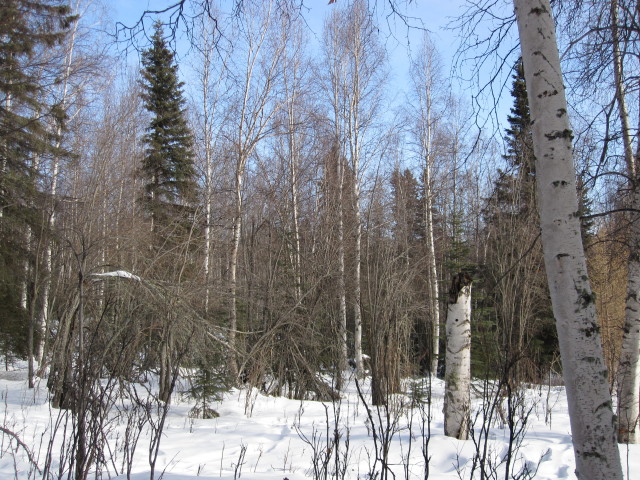
The
temperature was -2C, although the sun was shining brightly and there was
some melted snow and ice dripping from our roof. If you look carefully in
the second photo you can see moose tracks throughout the snow where moose
have been browsing on willow and birch branches.
We had seen some warmer temperatures in the 0 to 5 above C range until 2
days ago when it suddenly turned cold again. The snow has started to
compact as it melts and there are many ice-free patches on the roads. The
month of April is when we usually see some very big changes in our season:
most of the snow will melt, many of the first returning migrant birds will
arrive and, by the end of the month, we should have had blooming willow
buds ("pussy willows") and maybe even the first birch branches busting
their buds. Also, the returning daylight is truly remarkable right now.
Yesterday the sun rose at 701 am and set at 850 pm for a total daylight of
13 hours and 49 minutes, which is 3 hours and 30 minutes longer than this
day last month! Add to this the fact that April weather is often clear and
with the snow still on the ground, the long hours of sunlight reflecting
off the snow can be quite blinding. Don't go outside without your
sunglasses! I always take advantage of this extra energy from the sun to
spread wood ashes, which we have collected all winter long from our
furnace, on my snow covered garden. The change in the albedo of the dark
ash helps absorb heat energy from the sun and melts the snow quickly. This
way I can start working the soil as early as possible and plant my first
spinach, beets, lettuce, chard and kale greens early, maybe even before the
month is over. Already, even with the last two days being so cool, I can
see how the rate of melting under the dark ash is greater than elsewhere.
Adding the ash also fertilizes the soil with potassium and other nutrients,
which contributes to the richness of the soil.
I measured the depth of the snow in three places near my SIMB plot and
calculated a mean depth of 510 mm, which is 20 mm less than last month. We
did have additional snow accumulate since this time last month, so a lot
more snow has actually melted than if you just looked at these two values.
From reading our newspaper I see that although it seemed that we received a
lot of snow this year, we are still several mm under normal for total
accumulation. Looking back a year ago, we have much more snow now that we
did in April 2011, which was 443 mm.
Another sign of spring in our woods is hearing a Boreal Owl (Aegolius
funereus) calling in the evening or early morning hours. These are very
small owls, common to the boreal forest in the circumpolar region (northern
North America, Canada and northern Eurasia). They are only 21-28 cm long.
They are unique, I believe, being the only owl that hoots to attract a mate
rather than to establish a territory. Therefore, only the males hoot and
they only call in the spring and only until they have attracted a mate. We
love to hear their high, piping, quavering "OOOOOOOOO" but then always hope
that we will stop hearing it after a while, meaning that a couple has mated
and will be bringing young into the world. We constructed a wooden box,
using guidelines published by the Department of Fish and Game, and nailed
it to a spruce tree in the woods below our house. Every few years a pair of
owls will successfully rear a brood of young owls there. We hope this year
will be another good year for them! They hunt voles and lemmings and so are
very helpful to gardeners. Here is where you can hear what they sound like:
http://www.allaboutbirds.org/guide/Boreal_Owl/sounds